Broan 503 Exhaust Fan Ul Listed Number Lookup
Today I'm going to look at a sort o complex problem we've been debugging at AutoTrader recently (with a great deal of supporte from the Istio folks). Whilst this issue is largely solved, the steps we took English hawthorn help you debug issues in your personal deployments.
The Problem
We were noticing some requests were flunk on the first attempt, and and then organism retried automatically by Istio and subsequently succeeding. In traces (Jaeger), it looks like this - with the first request exhibit a 503 status inscribe with the response_flags of UC.

If you use Istio, or follow Istio, you'll likely have seen many issues around 503 errors. The general problem with the agency 503's are reported at the moment is it is a bit of a catchall.
Take apart this very hastate deterrent example:

Basically anything that goes wrong in Lotion 2's envoys communication with the application program will be engrossed finished Eastern Samoa a 503 and transmitted back to the upstream, and then the upstream leave retry.
Anyway, retries aren't end of the world, Istio is doing its job, detecting a unsuccessful person, retrying and and then subsequently returning a successful request to the upstream - all totally transparently - choke Istio. IT is worth noting that you're always going to stick failures - and you should build for them. We running play our applications spread across two-fold Availability Zones, indeed we'Ra going to see the odd blip, in that location's lots of things to go false.
However we were seeing around about 0.012% of requests go therein exact manner. We as wel rich person a microservice computer architecture, due to compound failure on a request which say touches 5 applications, you'd see around about a 0.08% failure charge per unit for the aggregate request. Non great and decidedly more than the "odd blip".
When you start to conceive about points of failure too, it's worth appreciating the added complexness that a sidecar model mesh adds to your applications communication. Nothing comes for free folk.
Pass on consideration that in a non-service-mesh world, consumer-gateway managed its connection pool to sauron-seo-app directly. Nonetheless in the serving-mesh world, we in reality have 3 separate connection pools, sooner than one. And for each one has its personal configuration:

-
consumer-gatewaytoreference-minister plenipotentiary(Configured in Java code) -
source envoytoaddress envoy(Configured in the DestinationRule) -
destination minister plenipotentiarytosauron-seo-app(Organized in Envoy and on by default, but not wheeler dealer configurable through Istio)
Plenty of opportunity for things to go erroneous, and also a much broader wander of places we need to look at to find the root causal agency. So let's play direct this real life scenario though and see where our issue is.
Metrics
Istio
Istio collects a whole bunch of prosody that can assistant us highlight problems. It's interesting really arsenic the steady of profile that Istio offers means it is apt highlighting problems you've had before! They're just forthwith in your face. So acceptive up prometheus and soda pop in:
sort_desc(heart and soul(changes(istio_requests_total{response_flags="UC", response_code="503", reporter="destination"}[24h])) by (source_app, destination_app, newsperson) >0)
What this is expression is: "Give me requests which resulted in a 503, with the response droop UC (upstream connector trouble) in the last 24 hours, sorted by source_app, destination_app and reporter).
Preeminence: Taking the deterrent example diagram I drew earlier, newsperson=source is the source envoy reporter=destination is the destination envoy.
Soh looking at my circus tent result: {destination_app="sauron-seo-app",reporter="destination",source_app="consumer-gateway"} 58 - this tells me that over the last 24 hours, 58 requests failed 'tween consumer-gateway to sauron-seo-app resulted in a 503UC and so were reported from the envoy next to sauron-seo-app.
O.k. great, we know we're having any issues at the destination, and this matches up with what we'Re beholding in our follow as the source is retrying to a assorted destination and succeeding. Let's break exterior what's going on with envoy.
Minister plenipotentiary
The next thing we privation to do is enable some metrics to help us debug envoy. By default, istio-proxy only enables some core envoy metrics to keep the footprint down. We want a little more information. Adding the next annotation to the Deployment will fall in you that:
sidecar.istio.io/statsInclusionPrefixes: constellate.outgoing,attender,cluster,cluster_manager,listener_manager,http_mixer_filter,tcp_mixer_filter,server,bunch up.xds-grpc
Note: These metrics are disabled aside default because they have relatively high cardinality. I in person only enable them when I'm debugging a problem, and turn them off afterwards.
In one case they're enabled, you'll have access to shiny prosody like envoy_cluster_upstream_cx_destroy_local_with_active_rq and envoy_cluster_upstream_cx_destroy_remote_with_active_rq. These metrics are from envoys perspective, so topical anaestheti and remote are as follows:

envoy_cluster_upstream_cx_destroy_local_with_active_rq
Summate connections destroyed locally with 1+ active quest
Sounds grim, right? Cipher wants active requests being killed and our destination minister plenipotentiary was reporting a whole bunch of remote destroys, and our source envoy had a whole bunch of topical anesthetic destroys.
IT can get a piece confusing, so I find the easiest way to debug is to graph them next to to each one new. You can see the local metric is being rumored on the source envoy, and the remote metric organism reported on the name and address.
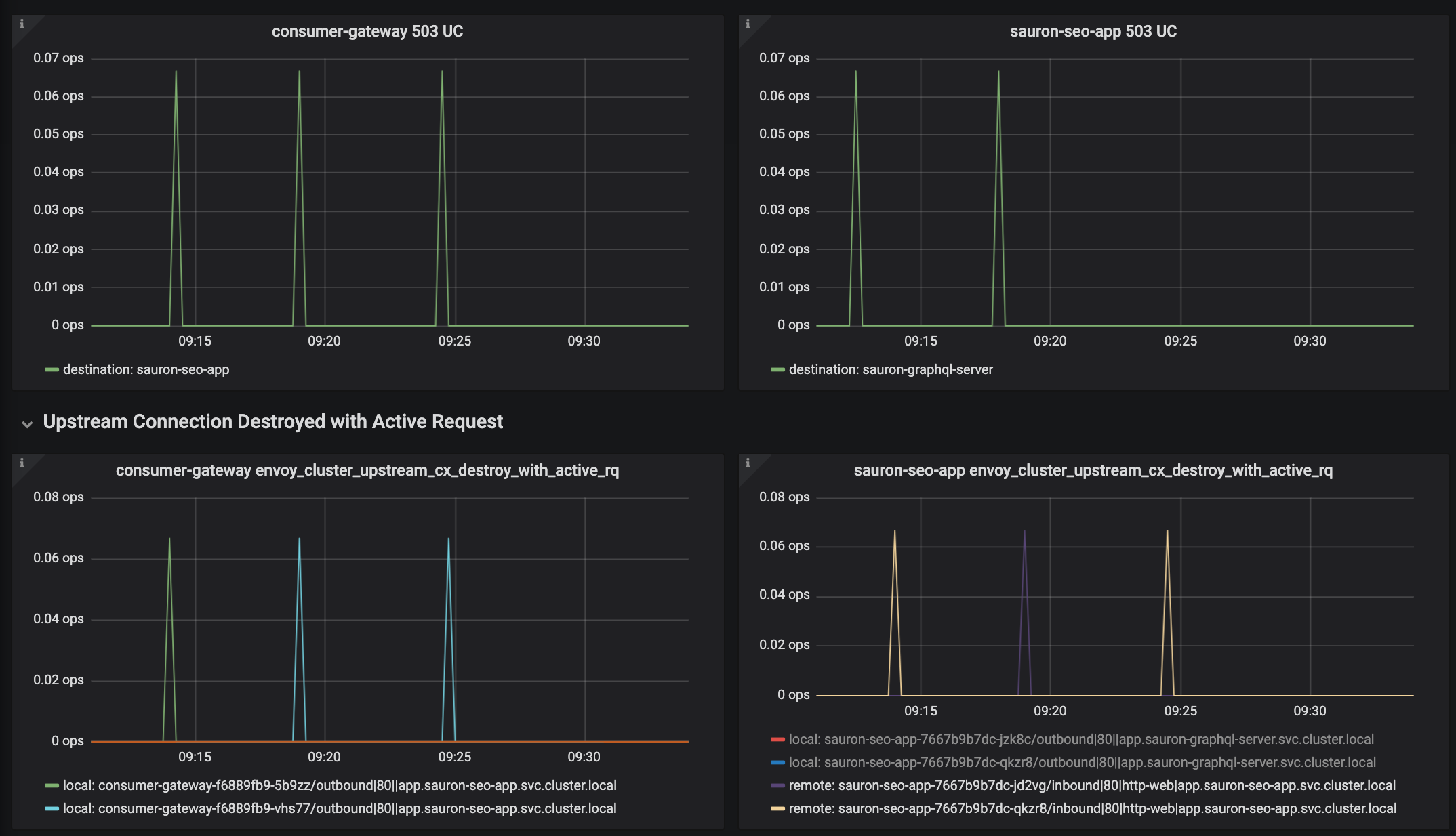
What this is basically telling us is that the connection between the sauron-seo-app emissary and application has been unsympathetic - and it looks like it was sauron-seo-app that closed it (remote confined). And so the consumer-gateway envoy is is subsequently closing that connection too. This makes sense equally consumer-gateway received a 5xx response on a http1.1 connecter (which is what envoy extraordinary to envoy uses in its connecter pool at the moment). No boost data can be transmitted thereon connection so IT has nary choice but to close it (local close).
Note: This isn't the subject for http2.0, and IT is look likely that Istio 1.2 wish have the ability to turn on http2.0 for envoys connection syndicate.
This confirms we need to narrow our investigation to sauron-seo-app.
Istio-placeholder debug logs
Istio-proxy enables you to on-off switch multiple log levels at run fourth dimension, which can help to debug these sorts of issues. So let's set all of them to debug, on sauron-seo-app and see what we behind find:
kubectl -n sauron-seo-app sauron-seo-app-7667b9b7dc-jd3vg -c istio-proxy -- curl -XPOST -s -o /dev/null http://localhost:15000/logging?tier=debug
And then you'll wish to rear end with kubectl -n sauron-seo-app logs -f sauron-seo-app-7667b9b7dc-jd3vg -c istio-proxy - be warned; these are very noisy. You'll make up looking at to find your 503 segment:
[2019-05-30 08:24:09.206][34][debug][router] [external/envoy/source/lowborn/router/router.cc:644] [C77][S184434754633764276] upriver readjust: reset reason connection conclusion [2019-05-30 08:24:09.206][34][debug][filtrate] [src/envoy/HTTP/mixer/filter.milliliter:133] Known as Mixer::Trickle : encodeHeaders 2 [2019-05-30 08:24:09.206][34][debug][http] [external/envoy/reference/unrefined/http/conn_manager_impl.cc:1305] [C77][S184434754633764276] encryption headers via codec (end_stream=false): ':status', '503' 'content-distance', '95' 'content-case', 'text/plain' 'date', 'Thu, 30 May 2022 08:24:08 GMT' 'server', 'istio-emissary' [2019-05-30 08:24:09.208][34][debug][connection] [external/envoy/source/common/network/connection_impl.cc:502] [C77] distant close [2019-05-30 08:24:09.208][34][debug][connection] [external/envoy/source/common/network/connection_impl.cc:183] [C77] closing socket: 0 Fine. We can see our 503 on connection [C77] - if we follow that back a little we tail end also see upriver reset: readjust reason connection termination on [C77]. Istio-proxy is telling United States that the upstream readjust joining 77 (the upstream in this case - being our application). Further validating our theory that envoy believes sauron-seo-app is closing the connection.
Packet Captures
At this point yet we've exhausted all the metrics Istio and Envoy make available to us, we've narrowed it down to the destination application seemingly terminating the connection. Time to mail boat trance and try and work out what is passing on.
In order to do this along kubernetes we misused a usefulness called ksniff. Which I ingest to be honest - is just brilliant. Every bit we run unprivileged containers we are unable to fare tcpdumps within the application. knsiff will:
- Observe what node your target app is running on
- Deploy a pod with an affinity to that guest, bound to the host network
- TCP Dump traffic from the privileged application and stream information technology right back to wireshark on your laptop computer as if it was local.
TCP Dumps are very noisy, so we would want to filter a little:
- We are looking for information about TCP connectedness events, so let's just anticipate
SYN,FINandRST. - As we're investigating traffic between the local anesthetic envoy and application, we simply want to consider localhost, so
-i lotestament target the loopback adapter.
kubectl sniff $cod -p -n $namespace -c istio-placeholder -f 'tcp[tcpflags] & (tcp-syn|tcp-fin|transmission control protocol-rst) != 0' -i lo
We were then very quickly able to see the connection RST, confirming the connection was indeed being blocked by our application.

Now this is perfectly reasonable, and envoi should be able to deal with upriver connections that are squinting. However in a very miniscule number (0.003%) of our requests, we were observant envoy attempting to send data on a connection that had been closed aside the application. The Istio team are still working on apprehension wherefore that is (likely a race condition between the host sending RST and emissary reusing a connector from its pool), and will be handling the scenario better (improvements are due 1.1.8+ onwards).
One bird of Jove eye'd Istio member did notice however was that there was forever roughly 5 seconds 'tween the connectedness starting (SYN) and the readjust (RST).
Our server was nodejs, and some quick googling around led Maine to the nodejs documentation which clearly states:
Timeout in milliseconds. Default: 5000 (5 seconds). The number of milliseconds of inaction a host needs to hold for additional incoming data, after it has finished writing the last response, before a socket testament personify war-worn. Ahhh interesting, soh even though envoy creates a connection pool to the diligence in that case the application will kill the socket if it's been out of work after 5 seconds! That's not very long at all.
TCP Socket Timeouts
We did some digging, as we weren't just seeing this in nodejs. We were sighted it to a lesser extent in python applications, and an even small extent in coffee/tom. IT turns out that they birth the pursual default socket timeouts:
- nodejs: 5 seconds
- Python: 10 seconds
- tom: 20 seconds
So the lower the socket timeout, the more RST we would get, and the Thomas More exacerbated the 503 issue would inst.
Even though the Istio team are actively looking at improving this mechanism, we determined we can quite easily put to work around it by scope a high socket keep alive setting in the destination covering.
Fixing it in express (nodejs):
const server = app.listen(port, '0.0.0.0', () => { logger.info(`App is now running on hypertext transfer protocol://localhost:${porthole}`) }) server.keepAliveTimeout = 1000 * (60 * 6) // 6 minutes Fixing it in cherrpy (pyhton):
global_config = { 'server.socket_timeout': 6 * 60, } cherrypy.config.update(global_config) Holdfast it in tomcat (Java-leaping):
host: plug in-timeout: 360000 Fix information technology in jetty (java-jetty):
ServerConnector connector = modern ServerConnector(jettyServer); Integer idleTimeoutInMinutes = 6; connective.setIdleTimeout(idleTimeoutInMinutes * 60 * 1000); And the result, suffer a guess what time we started rolling out the fixes:
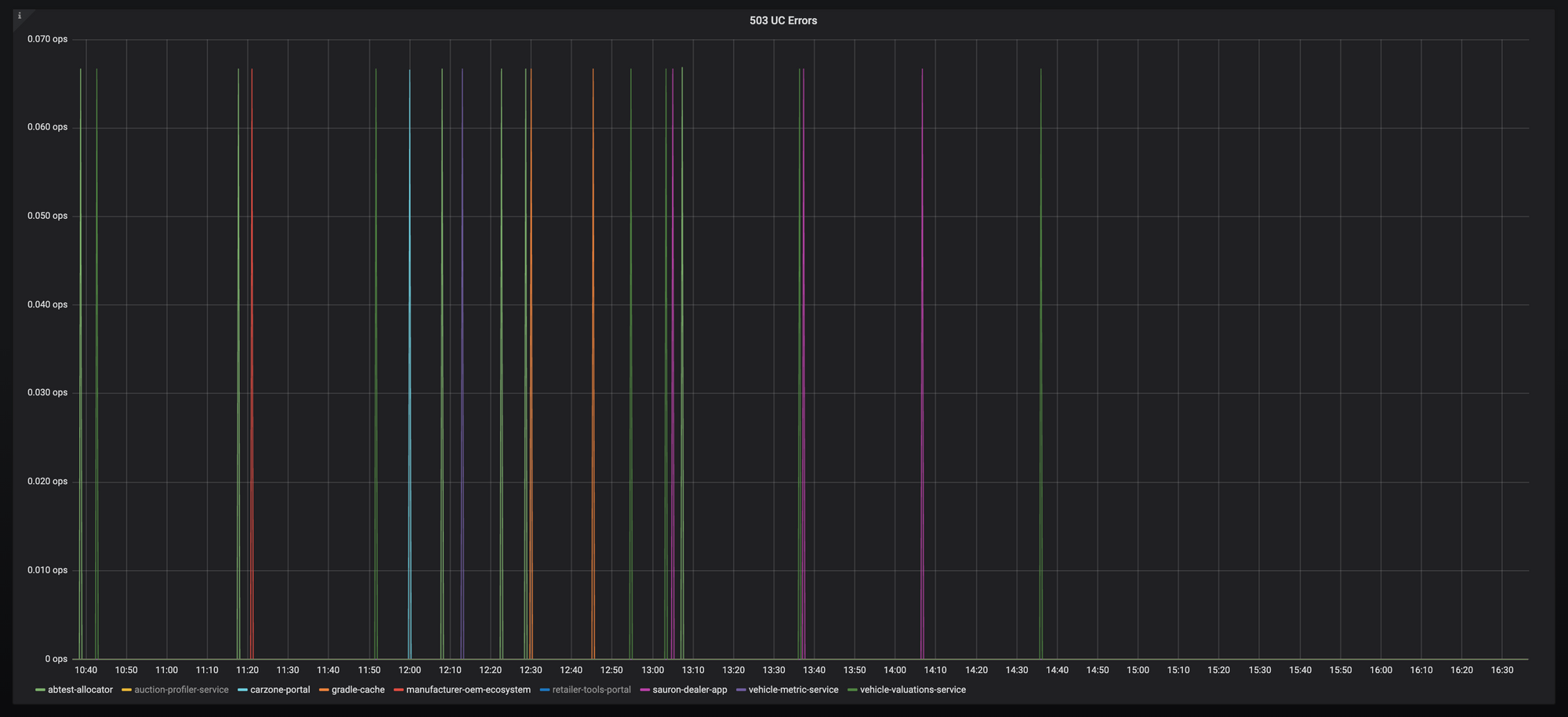
And that is the end of this cask of laughs.
I know the Istio team are focused happening improving the UX here, handling these sorts of scenarios Eastern Samoa efficiently as possible to make Istio as performant as possible out of the box for as many users as possible. So I'm confident it will only get better.
Big thanks to Chris McKean on my team for his help as well as numerous folks at Istio. Symmetric if you get into't have this specific issue; hopefully these debugging steps will help you get to the bottom of your ain.
Time for a beer.
Broan 503 Exhaust Fan Ul Listed Number Lookup
Source: https://karlstoney.com/2019/05/31/istio-503s-ucs-and-tcp-fun-times/

